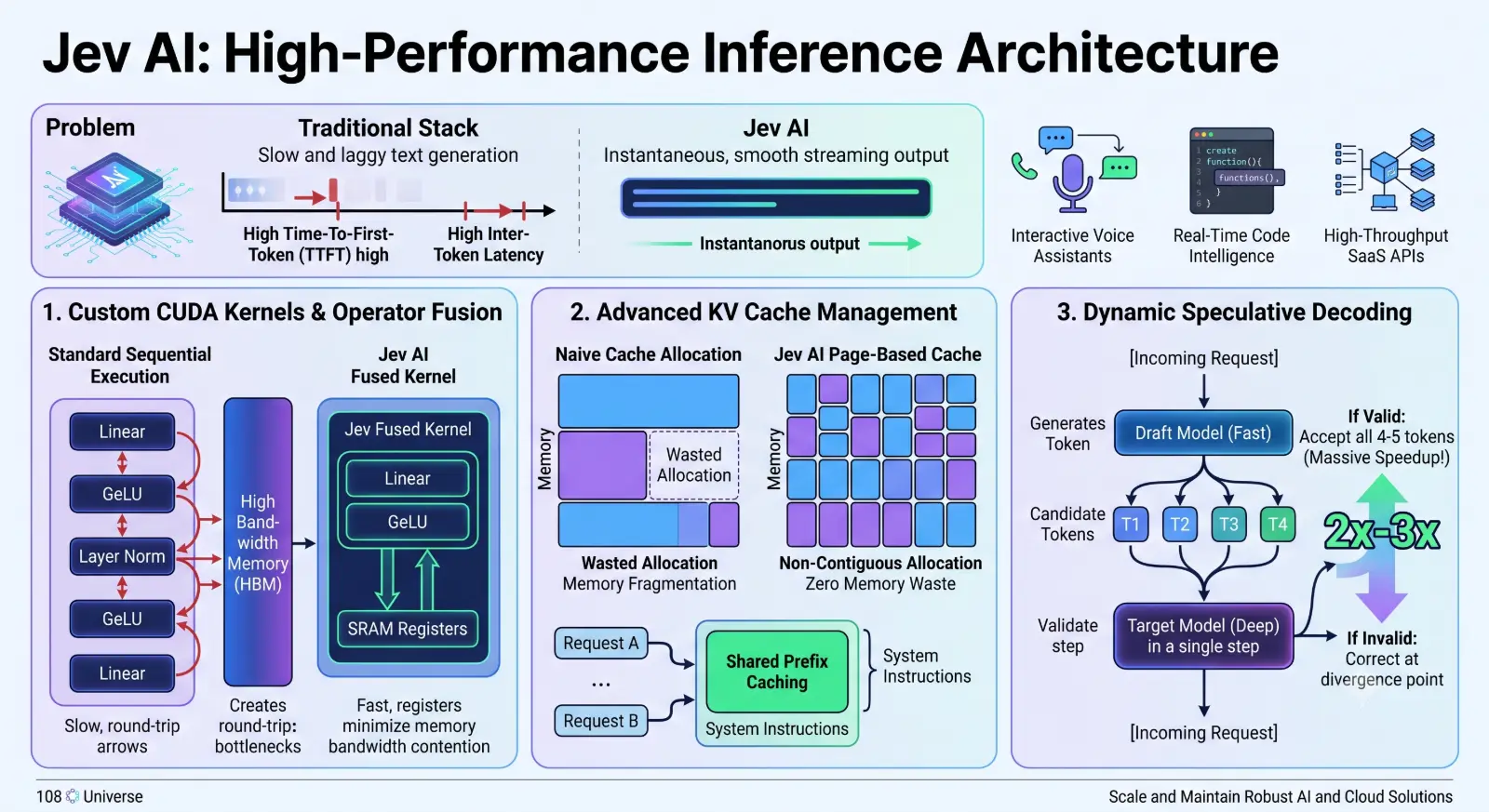
When evaluating AI infrastructure for production applications, latency is often the primary bottleneck. Traditional large language model setups suffer from sluggish time-to-first-token (TTFT) and high inter-token latency, making real-time features like live voice agents or instantaneous code completion feel frustratingly laggy. Enter Jev AI, a specialized approach to model execution and inference routing designed from the ground up for raw speed.
If you are a technical founder or engineering lead trying to build snappy, responsive AI features without blowing your cloud budget on over-provisioned GPUs, understanding Jev AI's performance profile is essential. This breakdown explores what Jev AI is, the mechanics behind its speed, and how to evaluate whether its architecture fits your next SaaS project.
What is Jev AI?
Jev AI is not a single foundational model like GPT-4 or Claude 3.5. Instead, it is an optimized inference runtime and routing layer designed to minimize the execution overhead of running modern transformer models. Think of it as a specialized engine built to squeeze every drop of performance out of underlying hardware, whether that hardware is an array of NVIDIA H100s or edge accelerators.
The core philosophy of Jev AI centers on removing the inefficiencies inherent in standard Python-based machine learning stacks. While standard setups often wrap model execution in layers of dynamic interpreter overhead, memory fragmentation, and inefficient scheduling, Jev AI tackles these issues at the systems level.
The Architectural Pillars of Speed
How does Jev AI achieve its notable speed advantages over default deployment frameworks? The performance gains do not come from magic; they stem from deliberate engineering choices across memory management, compilation, and execution scheduling.
1. Custom CUDA Kernels and Fusion
Standard machine learning frameworks execute layers sequentially, writing intermediate tensors back to High Bandwidth Memory (HBM) after every operation. This creates a severe memory bandwidth bottleneck.
Jev AI relies heavily on operator fusion—combining multiple operations (such as activation functions, scaling, and normalization) into a single custom CUDA kernel.
# Conceptual representation of standard sequential execution
def standard_layer(x, weights):
    linear_out = torch.matmul(x, weights)
    activated = torch.nn.functional.gelu(linear_out)
    normalized = torch.nn.functional.layer_norm(activated, [hidden_dim])
    return normalized  # Round trip to HBM between operations

# Fused kernel execution in Jev AI architecture
# All operations occur in SRAM registers, eliminating intermediate HBM round trips
By keeping intermediate states within the GPU's lightning-fast SRAM registers rather than writing them back to HBM, Jev AI dramatically reduces memory bus contention.
2. Advanced KV Cache Management
During autoregressive text generation, the Key-Value (KV) cache grows with every generated token. In naive implementations, this leads to memory fragmentation, out-of-memory errors, and wasted allocation because you must pre-allocate contiguous memory blocks for the maximum possible sequence length.
Jev AI implements page-based memory management for the KV cache, similar to virtual memory paging in operating systems:
Non-Contiguous Allocation: Memory blocks are allocated in fixed-size chunks dynamically as tokens are generated.
Zero Memory Waste: Fragmentation is virtually eliminated, allowing higher batch sizes without crashing.
Shared Prefix Caching: If multiple user prompts share the same system instructions or few-shot examples, the KV cache for those prefixes is computed once and shared across requests instantly.
3. Dynamic Speculative Decoding
To accelerate token generation rates, Jev AI utilizes an optimized implementation of speculative decoding. Instead of relying solely on a massive, slow target model to generate every token sequentially, the system pairs it with a smaller, highly efficient draft model.
[Incoming Request]
       │
       ▼
[Draft Model (Fast)] ──> Generates 4-5 candidate tokens in parallel
       │
       ▼
[Target Model (Deep)] ──> Validates all candidates in a single forward pass
       │
       ├──> If valid: Accept all 4-5 tokens (Massive speedup!)
       └──> If invalid: Correct at divergence point
Because validating a sequence of tokens in a single forward pass takes roughly the same time as generating a single token, this pipeline routinely yields a 2x to 3x multiplier in generation speed without sacrificing output quality.
Real-World Trade-Offs and Engineering Considerations
While the performance metrics are compelling, adopting an ultra-low-latency framework like Jev AI requires careful consideration of operational trade-offs.
Hardware Dependency: To extract maximum speed, Jev AI depends heavily on specific GPU architectures. Running it on older or consumer-grade hardware will not yield the same efficiency gains.
Model Compatibility: Custom-compiled kernels often require models to be exported into specific serialized formats. Fine-tuning unsupported architectures or custom model layers may require writing custom kernel bindings.
Cold Start vs. Warm State: While warm-state inference is exceptionally fast, model weight loading and KV cache initialization still require proper orchestration in auto-scaling cloud environments.
When Should You Choose a High-Speed Inference Stack?
Not every AI application requires microsecond-level optimization. If your backend simply generates a weekly email digest or processes batch analytics overnight, standard inference endpoints are usually sufficient and easier to maintain.
However, you should seriously consider high-performance inference routing if you are building:
Interactive Voice Assistants: Where latency over 300 milliseconds destroys the illusion of natural conversation.
Real-Time Code Intelligence: Where autocomplete suggestions must render before the developer finishes typing.
High-Throughput SaaS APIs: Where reducing compute time per request directly translates to lower AWS infrastructure bills and higher profit margins.
Building Scalable AI Systems
Achieving production-grade AI speed is rarely about swapping out a single component; it requires a cohesive strategy spanning model selection, memory management, and infrastructure orchestration. Whether you are fine-tuning open-source models on AWS or architecting a real-time RAG pipeline, performance optimization requires rigorous systems engineering.
If you are planning a high-throughput AI application and want to ensure your architecture is built for speed and cost efficiency from day one, book a free consultation with our engineering team at 108 Universe. We help founders and engineering leads build, scale, and maintain robust AI and cloud solutions.

Rohit Bairwa
Published on · 5 min read read