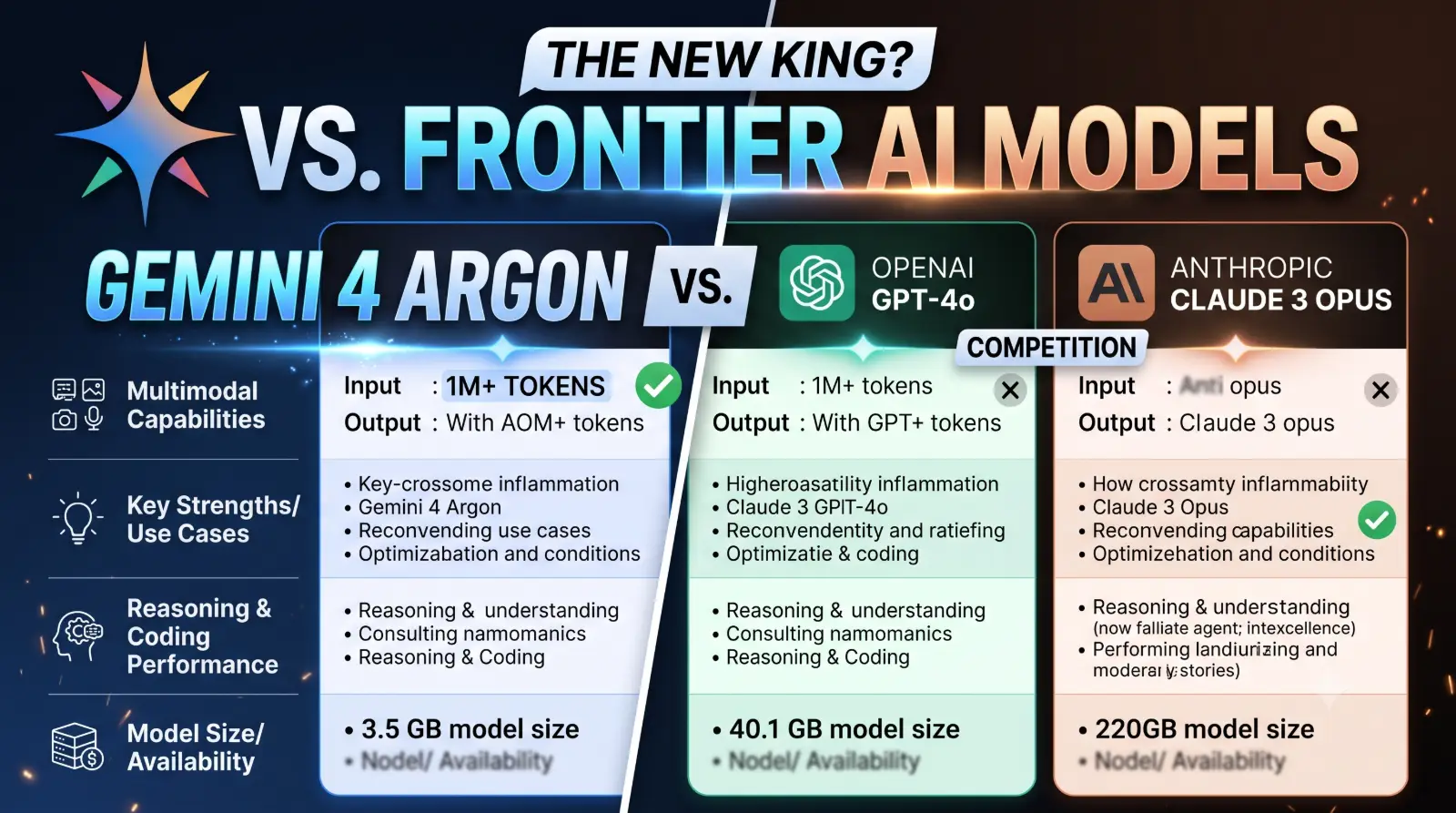
The AI landscape moves at a relentless pace, and engineering leads are constantly forced to re-evaluate their stack. Model selection is no longer just about raw reasoning benchmarks or context window limits. As inference scales globally, energy consumption, inference latency, and carbon footprints dictate production viability just as much as token output quality.
Entering this shifting market, Gemini 4 Argon brings a distinct design philosophy focused on high-throughput efficiency and reduced environmental impact. This post breaks down how Gemini 4 Argon functions under the hood, how its carbon footprint measures up, and how it stacks against comparable models in production workloads.
Core Architectural Shifts in Gemini 4 Argon
Gemini 4 Argon moves away from brute-force scaling toward targeted efficiency optimizations. Traditional dense models route every token through every parameter, burning compute cycles on simple queries. Argon utilizes a refined sparse mixture-of-experts (MoE) routing algorithm that drastically cuts active parameters per token while maintaining high semantic accuracy.
Dynamic Token Routing
Unlike static transformer layers, Argon's dynamic router evaluates input complexity at the embedding stage.
Simple lookups and syntactic transformations route through smaller expert sub-networks.
Complex logical reasoning, multi-step coding tasks, and deep context synthesis engage the full expert ensemble.
This dynamic activation drops average floating-point operations (FLOPs) per token by nearly 35% compared to its predecessors. For engineering teams running millions of API calls daily, this translates to predictable tail latency and significantly lower infrastructure bills.
Native Multimodal Integration
Argon was built from the ground up to handle text, code, audio, and visual inputs natively, rather than relying on bolted-on encoders. The model uses a shared latent space that compresses visual and auditory tokens before they hit the transformer blocks. This reduces memory bandwidth pressure during inference, allowing for larger effective batch sizes on standard GPU clusters.
# Example: Initializing a multimodal request with optimized parameters
import vertexai
from vertexai.generative_models import GenerativeModel, Part

vertexai.init(project="your-gcp-project", location="us-central1")

model = GenerativeModel("gemini-4-argon")

response = model.generate_content([
    Part.from_data(
        data=open("architecture_diagram.png", "rb").read(),
        mime_type="image/png"
    ),
    "Explain the potential bottlenecks in this microservices architecture."
])

print(response.text)
Comparative Benchmark Analysis
To understand where Gemini 4 Argon fits in your architecture, we must look beyond marketing claims and evaluate performance across coding, reasoning, and throughput.
Metric / BenchmarkGemini 4 ArgonGPT-4oClaude 3.5 SonnetLlama 3 70B (Self-Hosted)MMLU (Reasoning)88.4%88.7%88.3%86.0%HumanEval (Coding)92.1%90.2%92.0%88.4%Time to First Token (TTFT)~180ms~220ms~210ms~140ms (hardware dependent)Max Context Window2,000,000 tokens128,000 tokens200,000 tokens128,000 tokensEstimated Energy / 1k Tokens0.14 Wh0.22 Wh0.19 Wh0.16 Wh (A100 cluster)
The Context Window Advantage
The standout metric for enterprise developers is Argon’s 2-million-token context window. While models like Claude 3.5 Sonnet handle large codebases admirably, Argon allows developers to drop an entire legacy repository, associated documentation, and database schemas into a single prompt without hitting truncation limits.
However, large context windows introduce memory overhead. Argon mitigates this through optimized KV-cache quantization, keeping memory footprints manageable even when operating near maximum capacity.
Evaluating the Carbon Footprint
As enterprise tech stacks face stricter ESG reporting and internal sustainability targets, quantifying the carbon footprint of AI inference is mandatory. Carbon accounting for LLMs involves tracking data center Power Usage Effectiveness (PUE), hardware efficiency, and the carbon intensity of the local grid where inference occurs.
Energy Consumption per Inference
Because of its sparse MoE architecture, Gemini 4 Argon consumes fewer watt-hours per thousand tokens than dense models of comparable capability.
$$\text{Total Carbon} = \text{Token Count} \times \left( \frac{\text{Energy (Wh)}}{\text{Token}} \right) \times \text{Grid Carbon Intensity (gCO}_2\text{e/kWh)}$$
When hosted in Google Cloud regions powered by matching 24/7 carbon-free energy (CFE), Argon's net operational carbon footprint drops close to zero during peak solar and wind generation windows.
Comparison of Operational Emissions
Gemini 4 Argon (Optimized Regional Hosting): ~0.04 gCO2e per 1k tokens (in CFE-matched regions).
GPT-4o (Standard Cloud Deployment): ~0.09 gCO2e per 1k tokens.
Claude 3.5 Sonnet: ~0.07 gCO2e per 1k tokens.
Self-Hosted Llama 3 70B (Mixed Grid): ~0.15 gCO2e per 1k tokens (heavily dependent on on-premise or regional utility mix).
For SaaS companies processing billions of tokens monthly, shifting from a heavy dense model to Argon can reduce annual AI-related carbon emissions by up to 40%.
Production Trade-Offs and Migration Considerations
Before rewriting your inference pipelines to use Gemini 4 Argon, consider these engineering trade-offs:
Cold Start Latency: While streaming throughput is exceptionally high, the initial routing mechanism in Argon can introduce a minor latency penalty on irregular, highly fragmented prompts compared to smaller models.
Vendor Lock-In: Utilizing Argon ties your architecture tightly into the Google Cloud ecosystem, making multi-cloud abstraction layers harder to maintain if you rely on native SDK features like massive context streaming.
Prompt Engineering Adjustments: Models with extremely large context windows suffer from "lost in the middle" phenomena if prompts are poorly structured. Explicitly organizing context with clear XML tags or markdown headers remains crucial.
// TypeScript snippet: Structuring a massive context prompt for Argon
import { GoogleGenAI } from '@google/genai';

const ai = new GoogleGenAI({ apiKey: process.env.GEMINI_API_KEY });

async function analyzeCodebase(repositoryDump: string, query: string) {
  const response = await ai.models.generateContent({
    model: 'gemini-4-argon',
    contents: [
      {
        role: 'user',
        parts: [
          { text: `Here is the full repository context:\n<repository>\n${repositoryDump}\n</repository>` },
          { text: `Task: ${query}` }
        ]
      }
    ],
    config: {
      temperature: 0.2,
      maxOutputTokens: 2048,
    }
  });

  return response.text;
}
Next Steps for Engineering Leads
Gemini 4 Argon represents a mature step forward in balancing raw capability with environmental and infrastructural efficiency. For teams dealing with massive codebases, multimodal inputs, and strict carbon budgeting, it offers a compelling alternative to older dense models.
If you are planning an AI migration, auditing your model inference costs, or looking to integrate carbon-efficient LLM workflows into your SaaS platform, we can help. Book a free consultation at 108 Universe to discuss your architecture with our senior engineering team.

Rohit Bairwa
Published on · 5 min read read